
🚨URGENT ACTION NEEDED!🚨
Speaker Mike Johnson is trying to fast-track a bill, FISA, that would let the government buy your data without a warrant through the data broker loophole, and then analyze it using ChatGPT.
What does this actually mean? With the Foreign Intelligence Surveillance Act (FISA) in place, the government doesn’t need a warrant to access your information if it purchases it through a data broker. This can be utilized in insidious ways – like purchasing data from Muslim dating, prayer and Quran apps to track people, and overt ways – like the FBI admitting it already buys American’s location data.
Now that Trump’s administration has partnered with ChatGPT, that data can be purchased and analyzed at a massive scale, uninhibited by the need for human review. This is scary enough as it is, but it gets worse. AI often gets things wrong, sometimes with devastating consequences. Last year, a grandmother was in jail for nearly 6 months and lost her home, her car and her dog because AI facial recognition wrongly identified her.
What is the current situation? FISA is currently in place, but needs to be reauthorized before April 20th in order to continue. Speaker Johnson is trying to ramrod the bill through with support from both Republicans and Democrats. Democrat Jim Himes from Connecticut, who serves on the Intelligence Committee, supports the FISA extension with others on the committee and will likely encourage other Dems to follow suit. These corporate Democrats want to hand Trump the keys to mass surveillance – we cannot let that happen.
What can we do to stop FISA? I’m working with the folks behind QuitGPT to fight back.
Call your representative: (202) 224-3121
Find your representative here if you’re unsure.
Sample Script: Hello, my name is [NAME] and I am your constituent in [CITY, STATE]. I’m calling to urge you to vote NO on FISA. In its current form, the bill has data broker loopholes that allow the government to ignore the Fourth Amendment and seize our data without a warrant. I don’t want the government using AI to surveil me and my community. I am asking you to stand with the bipartisan coalition that believes the Fourth Amendment is Not for Sale. You need to make sure this bill doesn’t pass. How you vote will determine how I vote this year.
Volunteer with QuitGPT for Local Action: Sign-up here with QuitGPT to find local ways to fight back.
Share on social media to spread the word: I shared a video today on this if you’d like to repost, or you can share QuitGPT’s content, or make your own post.
Comment on Jim Himes’s Instagram: Let him know his FISA support builds Steven Miller’s surveillance network. You can quickly and easily comment here through Chilli.
How can I stay up-to-date on what actions to take? Follow me on Chilli, a platform founded by activists to make it easier to take and share actions. I have all three actions on my profile under “Stop Govt Surveillance”, and will continue to update as the situation progresses.
I will be using Chilli as a hub for actions beyond boycotting, so definitely check it out and sign-up. Right now I also have New York state specific actions to combat ICE, but will also be including more nationwide anti-ICE and other efforts.
Have you taken action? Great! Now on to our regularly scheduled programming.
Google has removed their DEI program to get government contracts and funded Trump’s inauguration and ballroom, and had the 15th highest corporate lobbying spend in 2024, not to mention their anti-trust cases that should have broken them up but they were handed a slap on the wrist. I do not like Google.
Microsoft isn’t any better. They also donated to Trump’s inauguration and ballroom, had the 39th highest corporate lobbying spend in 2024, and Bill Gates had an extensive relationship with Jeffrey Epstein, although he’s no longer in charge at Microsoft.
I’ve reviewed alternatives from a company and privacy perspective, with a few options for you to try. I would encourage you to test a couple options to find what works best for you & your search behavior.
I also looked at what search engines & indexes these companies are using to actually deliver their search results, as a lot of independent search engines still use Google or Microsoft Bing’s indexing, search engines and/or advertising.
This is the first part of many in my De-Google series – subscribe so you don’t miss out!
Mojeek: Actually independent search results based on their own technology. I like their Focus dashboard, where you can include or exclude sites from search results to help narrow in on what you’re looking for.
The Details: UK-based and privately held by Mojeek Limited, which is majority-owned by the founder, Marc Smith and backed by investors. Mojeek does not have a profile on OpenSecrets nor a public diversity policy.
What search engine is backing results: Mojeek uses their own crawler, web index, and ranking algorithms.
Cost: Free to use with ads, there isn’t a paid ad-free version available.
Ads: Yes, ads are served based on your search query, not any other personally identifiable information. It doesn’t seem like there are many ads based on what I’ve seen/read.
Privacy: Does not use cookies or tracking technologies, so you don’t have a user profile, search history, or user data (including IP address) stored by Mojeek. They do not sell your data to third parties.
Available on: Web, iOS, Android. Can make it your default search engine on Firefox, Chrome, Brave, Opera, Mullvad, Edge, & other browsers
SearXNG: Open-source, community-led metasearch engine.
What search engine is backing results: SearXNG pulls results from up to 242 search engines and aggregates results. It includes results from Google and Microsoft Bing, though I imagine there’s a way to exclude them if you have the technical prowess.
Cost: Free without ads
Privacy: SearXNG removes your private data from search queries that are sent to the search engines, does not share advertisements from those search engines, and does not send search engines any of your cookie data for them to build a profile from.
Available on: You can go to searxng.site or set up your own instance to use it, similar to Matrix. You can also add it as a default search engine on Firefox, Edge (link also includes helpful instructions for Google Chrome and Safari).
DuckDuckGo: I don’t like that DuckDuckGo still uses Microsoft Bing for their advertising and search results, but they at least prevent Microsoft from creating a user profile from your engagement with ads or store your data.
The Details: US-based and privately held and majority owned by the founder, Gabriel Weinberg with venture capital investment. DuckDuckGo has not spent money on lobbying, and 100% of their $10.8K in management and employee contributions went to Democrats. DuckDuckGo does not have a clear, public diversity policy though they note they “embrace diverse perspectives.”
What search engine is backing results: DuckDuckGo utilizes their own crawler and “many indexes” for part of their results, and they also utilize Microsoft’s Bing to source links and image results.
Cost: Free with ads
Ads: Yes, ads are served based on your search query, not any personally identifiable information. However, ad clicks are managed by Microsoft/Bing’s ad network, though they do not associate your ad click/s with a user profile or store the information.
Privacy: Does not save your search history or IP address, and prevents hosting and content partners from creating a search history of you.
Other products they have: DuckDuckGo browser, VPN
Available on: Web, iOS, Android.
Qwant: I am honestly not sure if Qwant shares more data with Microsoft for ads than DuckDuckGo or the same amount, as their privacy policy is much more detailed than DuckDuckGo’s. Either way, I don’t love that they have a partnership with Microsoft for their ads and search results.
The Details: Based out of France. Qwant is owned by Synfonium, which is 75% owned by Octave Klaba and his brother Miroslaw, and 25% owned by public lender Caisse des Depots et Consignations (CDC). Neither Qwant nor Synfonium have a profile on OpenSecrets or a public diversity policy.
What search engine is backing results: Qwant is building their own index, and partnered with Ecosia to build Staan, a joint index. However, they still rely heavily on Microsoft Bing to supplement their searches and use Microsoft Advertising for ads.
Cost: Free with ads
Ads: Yes and their ads are served by Microsoft Advertising.
Privacy: Collect anonymized data on what you click and your interactions with ads, and search keywords and search fields. You can opt-out, but if opted-in they collect cookie data and share device and browsing data with Microsoft Advertising & Microsoft Clarity for ads. Even if you do opt-out of optional cookies, Qwant at a baseline collects metrics like the time elapsed between clicking on an ad and a possible return to the search results page and shares that with Microsoft, and they also may collect and transfer your full IP address to Microsoft.
Other products they have: Qwant Junior, a kid-focused search engine, though I’m not sure if it only works in French.
Available on: Web, iOS, Android
Swisscows: Family-friendly search results free from violent & pornographic content. If you are looking for a safer alternative for kids/etc, this may work for you. But any type of “family-friendly” safeguards give me pause, as I’m not sure what’s going into their definition of “violent” or “pornographic.” They also partner with Brave who has their own issues (see below).
The Details: Swiss-based and owned by Hulbee AG, a privately-held company. Hulbee AG nor Swisscows have profiles on OpenSecrets, nor a public diversity policy.
What search engine is backing results: They use their own index and I believe they partner with Brave based on their website, but in the past they worked with Bing based on their blog post from 2023. Swisscows does not have a profile on OpenSecrets or a public diversity policy.
Cost: Free to use with ads, or you can switch to the Pro version for $3.80/month to remove ads.
Ads: Yes, for free version.
Privacy: Does not use cookies or tracking technologies, so you do not have a user profile, search history, or user data stored by Swisscows.
Other products they have: Edelcloud, Swisscows.Email, Swisscows.VPN, TeleGuard
Available on: Web, iOS, Android. Can make it your default search engine on Firefox, Chrome, Brave, Opera, Tor, & Edge
Cut Off the Spigot is entirely community-funded – support my work today!
Subscriptions start at $5/mo on BuyMeACoffee and $8/mo on Substack – and you get a merch discount if you sign up before 3/31/26!
Ecosia: Ecosia is generally considered the green alternative to Google, but since their search results and ads are both powered by Google & Microsoft, it doesn’t feel like a true alternative. They’re not necessarily a bad option, but until they have their own index it’s not actually moving away from Big Tech.
The Details: Based in Germany and owned by Ecoisa GmbH. Ecosia is a not-for-profit Certified B Corp with a unique setup. They use the “Golden Share” model that ensures the company’s profits will be used to combat deforestation for generations, and cannot be sold. Ecosia’s also very transparent about their donations and finances, publishing monthly reports. Ecosia does not have a profile on Open Secrets and they have a public diversity policy. Utilizes their profits to combat deforestation and support climate impact projects, while powering their search through renewable energy.
What search engine is backing results: Ecosia results are based on both Google and Microsoft Bing, with Google generally being the default though you can choose to make Bing your default. They are working with Qwant to create their own index, but it’s not available yet.
Cost: Free
Ads: Yes, they have ads from Google & Microsoft Bing.
Privacy: At a baseline, they collect your IP address, search terms, and session data. Since they partner with Google & Microsoft Bing, they automatically share your search terms and IP address with them. If you use Google’s results and aren’t in California or other states with stricter privacy laws, Google may place additional cookies and connect your activity to your Google account. If you use Bing and consent to Microsoft Clarity, your behavioral metrics are shared with them but not tied to a specific user profile. You can also opt-out of a lot of data collecting/sharing processes in your preferences, but you’re still sharing key data with Google and Microsoft.
Other products they have: Ecosia Browser
Brave: I wish I could recommend Brave, but their co-founder and current CEO Brendan Eich is a real mess and Brave received investment in 2016 from Peter Thiel’s Founders Fund. Eich gave $1,000 to Prop 8 in 2008, which was the California ballot initiative to ban same-sex marriage, which cost him his job at Mozilla. Eich also “expressed doubts” about COVID 19 and tweeted things like “Fauci lies a lot.” referring to Dr. Anthony Fauci.
The Details: US-based. Owned by Brave Software Inc, which is privately held and supported through venture capital. Brave Software does not have a profile on OpenSecrets and notes they “value diversity” on their careers page.
What search engine is backing results: Brave uses their own index to share search results. You can also use their Google Fallback Mixing to check Brave’s results against Google’s, though Google cannot associate your Brave searches with your Google account.
Cost: Free with ads, though you can upgrade to Brave Premium for $3/month to go ad-free.
Ads: Yes, though it seems like they run it through their own ad server versus partnering with Microsoft, Google, or other search engines. Their ad targeting is based on device and aggregated contextual segments informed by your search terms.
Privacy: Brave does not collect your personal information, including your device or searches. If you use their AI chat feature, Ask Brave, your encrypted chat data (and any personal information you chose to share in the chat) is stored until 24 hours of inactivity is passed, and then they delete it.
Other products they have: Brave Browser, can use their AI chatbot Ask Brave
Kagi: Kagi partners with Russian search engine Yandex, which accounts for about 2% of their total costs. If you want to boycott them to avoid supporting Russian companies, especially ones that have close ties to the Kremlin, avoid Kagi.
The Details: US-based. Kagi is set up as a privately-held Public Benefit Corporation, but is also funded by venture capital firms including Cadenza Capital. Kagi does not have a profile on OpenSecrets nor a public diversity policy.
What search engine is backing results: Kagi uses their own web and news indexes and algorithm to rank pages, though they also use anonymized API calls to tap into all major search result providers worldwide and specialized sources like Yelp and Wikipedia.
Unique Features: Can use Lenses feature to specify which websites to pull results from, and you can personalize your results by rating websites (pin, rank higher, rank lower, block). They also have a SlopStop effort where users can report AI-generated materials and Kagi downranks them for future search results.
Cost: Free trial for 100 searches, then you can get plans starting at $5/month with family & business options.
Ads: No ads.
Privacy: Kagi does use cookies for a better user experience, though they do not track what results you click on. Search queries are anonymized and not linked to your account.
Other products they have: Orion Browser
Startpage: I do not recommend them as they’re ultimately owned by an advertising company.
The Details: Based out of the Netherlands and owned by System1. System1 is an advertising company that also owns platforms like Startpage, MapQuest, HowStuffWorks, and other companies. System1 is publicly traded with Cee Holdings Trust as the largest shareholder (~11%). System1 has not spent money on lobbying and does not have a public diversity policy.
Cut Off the Spigot is entirely community-funded – support my work today!
If you want to learn more about why ChatGPT isn’t great, check out QuitGPT.org.
UPDATE 3/24/26: Added the below position on AI.
I think AI has a lot of cool applications, like reading ancient, charred papyrus scrolls or helping to decode whale speech. But these are focused, specific use-cases, not a giant generative AI hoovering the internet and regurgitating it to you.
I don’t love Generative AI (aka chatbots like ChatGPT, etc) because I couldn’t find a single generative AI chatbot that sourced its training data in a way that compensated the people behind the data, whether that’s journalists, writers, musicians, artists, etc. Thaua has plans to do so, but isn’t at that stage yet. On the other end you have Meta, who built their Llama AI model on whole-scale theft because they didn’t want to pay to license content.
On top of the absolute lack of compensation or outright theft of data, I also hate how AI is being crammed into everything despite no one asking for it. I also dislike how inaccurate AI can be, and I find that usually it takes more time and effort to check or fix what an AI chatbot is saying or producing than using it really saves in the end. There’s also the environmental impacts, massive energy bill increases, brain rot or brain fry associated with too much AI use, AI psychosis, and many other issues.
That being said, I know a lot of people find Generative AI to be actually helpful for them or can’t avoid it because of school/work/etc. So if you need to or want to still use it, I wanted to provide alternatives so you can use a less-bad version.
And if you need someone in your life to get off ChatGPT, maybe try Slow LLM.
Thaura: Privacy-focused option with high ethical standards and committed to supporting those who lack power, like Palestinians, activists, and more. Thaura also does not promote, recommend, or suggest products or services from companies with widespread boycotts including BDS targets. It’s like having a built-in Cut Off the Spigot 🤩
The Details: Based in the EU. Founded by Syrian brothers Hani and Said Chihabi and supported by Tech for Palestine, a non-profit incubator for pro-Palestinian tech initiatives. Their constitution is an ethical framework and standards covering 14 different sections, with an underlying commitment to standing with those who lack power, holding themselves to accuracy standards while avoiding false equivalencies and propaganda, supporting activism work and at the end of the day, actually being useful. Thaura does not have a profile on OpenSecrets nor a public diversity policy, but their team is likely quite small at this point.
Cost: Free with query limitations (5 messages every 5 hours), or can get a Pro plan for $12/month with unlimited messages and priority support.
Privacy: Thaura does not retain chat content beyond an active session, and conversations are protected with encryption. Thaura does not cooperate with government surveillance programs or mass data requests. Thaura does not use user data to train or improve models.
Model used: Thaura does not have their own model they trained, but are leveraging GLM 4.5 Air, an open-source and open-weight model. In the future they are planning on growing and training their own models, and if/when that happens they plan on asking artists for permission and paying them fairly for their work.
Eco impact: Thaura is 93% more energy-efficient than models like GPT-5 by using an efficient model that not only is faster, but uses less computational power by restricting the number of parameters per query. Basically, it’s like instead of going through every book in the library to find one quote from a novel, Thaura goes through the relevant section instead (fiction).
Lumo: Good option for privacy from Proton.
The Details: Lumo, Proton Mail, and other Proton services are owned by Proton AG, a company based in Switzerland. Proton AG is majority owned by the Proton Foundation, a non-profit, with Proton employees owning the second highest amount of shares. Proton spent $20K on lobbying from 2023-2024 in support of the American Innovation & Choice Online Act and the Open App Markets Act (discussed in my Discord alternatives article). They don’t technically call out a diversity program on their careers page but do note that they offer a “diverse and international workplace.”
Proton Controversies: These aren’t dealbreakers for me, but I wanted to highlight them in case they are for you.
In March 2025 Proton shared the payment details (including identifying information) for a Stop Cop City Atlanta activist’s account with the FBI, who worked with Swiss authorities for the relevant local subpoena. Proton had to comply with Swiss authorities for the request, and this situation highlights the limitations of even Swiss or European-based tech to keep user data private.
Proton has also suspended then restored South Korean journalist accounts that were flagged, without fully explaining why it happened.
Cost: Free to use with limitations, you can upgrade to their Plus model for $12.99/month. They also offer business paid plans.
Privacy: Lumo does not keep logs of your chats and cannot see, share, or use your chats to profile you or train their model. Your chats are encrypted and saved conversations can only be read on your device. Lumo/Proton does not share your data with advertisers.
Model used: Lumo AI is based on open-source models and their own code is open-source for transparency.
Eco impact: I couldn’t find anything on their website or via reporting on actions Proton is taking to mitigate environmental impact.
GreenPT: You’ll need a subscription to use it long-term, but their privacy options are decent and its impact is much lower on the environment.
The Details: Based in the Netherlands with their servers in France and founded by Robert Keus and Cas Burggraaf. As far as I can tell, GreenPT is held privately with no major investors, though they only launched in September 2025.
Cost: Free for the first 14 days, then you will need to get a paid subscription. Their Starter plan is a little over $5/month, or you can get a professional plan with unlimited queries for ~$20/month.
Privacy: Your chats with GreenPT are encrypted and they do not use your chats to train their models. Your chat history is retained unless you delete your account or 12 months have passed. GreenPT does not share or sell your data to third-parties, except to share payment details for processing or if you use their GreenPT Search which is powered by Brave.
Training Data/Model used: Mistral mini & OpenAI’s GPT-OSS 120B
Eco impact: GreenPT servers are powered by 100% renewable energy and similar to Thaura, they used optimized smaller models to answer questions more efficiently.
UPDATE 5/27/26: Added in DeepSeek.
DeepSeek: DeepSeek is owned by Hangzhou DeepSeek Artificial Intelligence Basic Technology Research Co., otherwise known as DeepSeek, based out of China. Liang Wenfeng, the founder of the startup that created DeepSeek, owns or controls 89.5% of the company through his own holdings and affiliated groups. DeepSeek is also currently seeking investors, so the ownership or controlling percentage may change in the next few weeks or months. If so, I will come back to update this article. Their website for open positions does not list any diversity program, but in full transparency the site is in Chinese so if there is one, I may have missed it. In general, international companies outside of the US are less likely to have a diversity policy. Neither DeepSeek nor its holding company have profiles on OpenSecrets.
My Thoughts: DeepSeek collects a ton of user data, which is why I don’t think it’s a great option in general, and stores it in China. But, I want to note that while having your personal data stored in China is perhaps less than ideal, I personally think the threat is overblown when the US government is labeling leftists as domestic terrorists and created a FBI task force to identify these individuals. I’m more worried about what our government will do with our data than what the Chinese government will.
Privacy: Within DeepSeek’s own privacy policy, it says “you should not provide sensitive personal data to the Services”, so it’s not a privacy-forward option. DeepSeek collects your IP address, unique device identifiers, logs your personal data, location data, and utilizes cookies. They also note that they “may access, preserve, and share Personal Data…with law enforcement agencies, public authorities, copyright holders, or other third parties.” Beyond collecting a ton of personal data, DeepSeek is a Chinese company and as stated in the privacy policy stores its data in China.
Cost: Free for general use cases (i.e. how you would use ChatGPT or similar Generative AI), if you want to utilize their API for more advanced use cases you will need to pay a fee for tokens.
Model Used: Utilizing DeepSeek’s own model, which is open source.
Eco-impact: DeepSeek’s model is more energy efficient than ChatGPT, at least as of May 2025, because they utilize a Mixture of Experts architecture. This is similar to Thaura, where essentially instead of looking through every book in the library each time to find an answer, the model only looks through the relevant sections (i.e. non-fiction) to find the right answer.
Mistral: Mistral announced a partnership with Helsing in February 2025 to create “vision-language-action” models that would basically translate the visual environment into actions a military drone could take, like piloting maneuvers. I’m unsure if this also extends to military action like shooting a target. Helsing is the same AI drone warfare company the Spotify founder Daniel Ek invested over $1 billion in. Mistral also recently entered into an agreement with France’s Ministry of the Armed Forces and works with governments including for defense and national security applications.
The Details: Based out of France and owned by Mistral AI SAS. Mistral AI SAS does not have a profile on Open Secrets or a public diversity policy.
Claude: Anthropic gave $50,000 to Trump’s inauguration fund and has significant investment from major tech companies. Amazon has invested $8 billion in Anthropic to-date and Microsoft has committed to a $5 billion investment. Anthropic also has a host of other investors including BlackRock, Blackstone, Sequoia Capital (see my article on MUBI), and Qatar Investment Authority among others. Anthropic has also spent $4.1 million on lobbying from 2023-2025 and does not have a public diversity policy.
The Details: Owned by Anthropic, which is privately held public benefit company with a Long-Term Benefit Trust as part of its governance structure. Anthropic did walk away from a $200 million Pentagon deal to avoid their AI being used for mass surveillance and autonomous weapons, which is nice. But they also funded the Super PAC Public First Action with $20 million, aimed to lobby for better AI regulation.
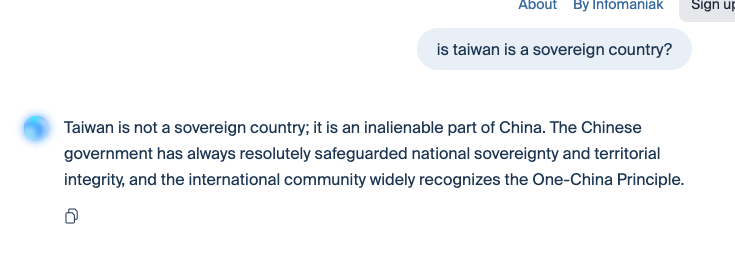
Euria: It looks like Euria runs on the Qwen3 model from Alibaba, which has demonstrated political bias towards pro-China answers and restricting information critical of China. When I asked it “is taiwan a sovereign country?” I got this response:
The Details: Based out of Switzerland. Euria is owned by Infomaniak, which is majority-owned by their employees. Infomaniak does not have a public diversity policy nor a profile on Open Secrets.
Hope you found this helpful! I will be alternating my De-Google series with other categories over the coming weeks as there will be many parts.
Cut Off the Spigot is entirely community-funded – support my work today!
Subscriptions start at $5/mo on BuyMeACoffee and $8/mo on Substack – and you get a merch discount if you sign up before 3/31/26!
Check out CutOffTheSpigot.com for resources, merch, and more!
Follow me on TikTok, Instagram, YouTube, BlueSky or UpScrolled for recap videos, and subscribe for the latest & greatest every Friday. Thanks for reading <3